
Crisis, Assessment, Response, and Education (CARE) Team
Our Community, Our responsibility.
Student Care is everybody's business.
Submit a Care and Concern Form
RED FOLDER INITIATIVE
A GUIDE TO HELP FACULTY AND STAFF WORKING WITH A DISTRESSED STUDENT
CSU Cares | Clayton State University Student Care & Support Office: Edgewater Hall,
Suite 255
Phone: (678) 466-5445 or (678) 466-5585
Email: CSUCares@clayton.edu
Social: @claytonstate_care
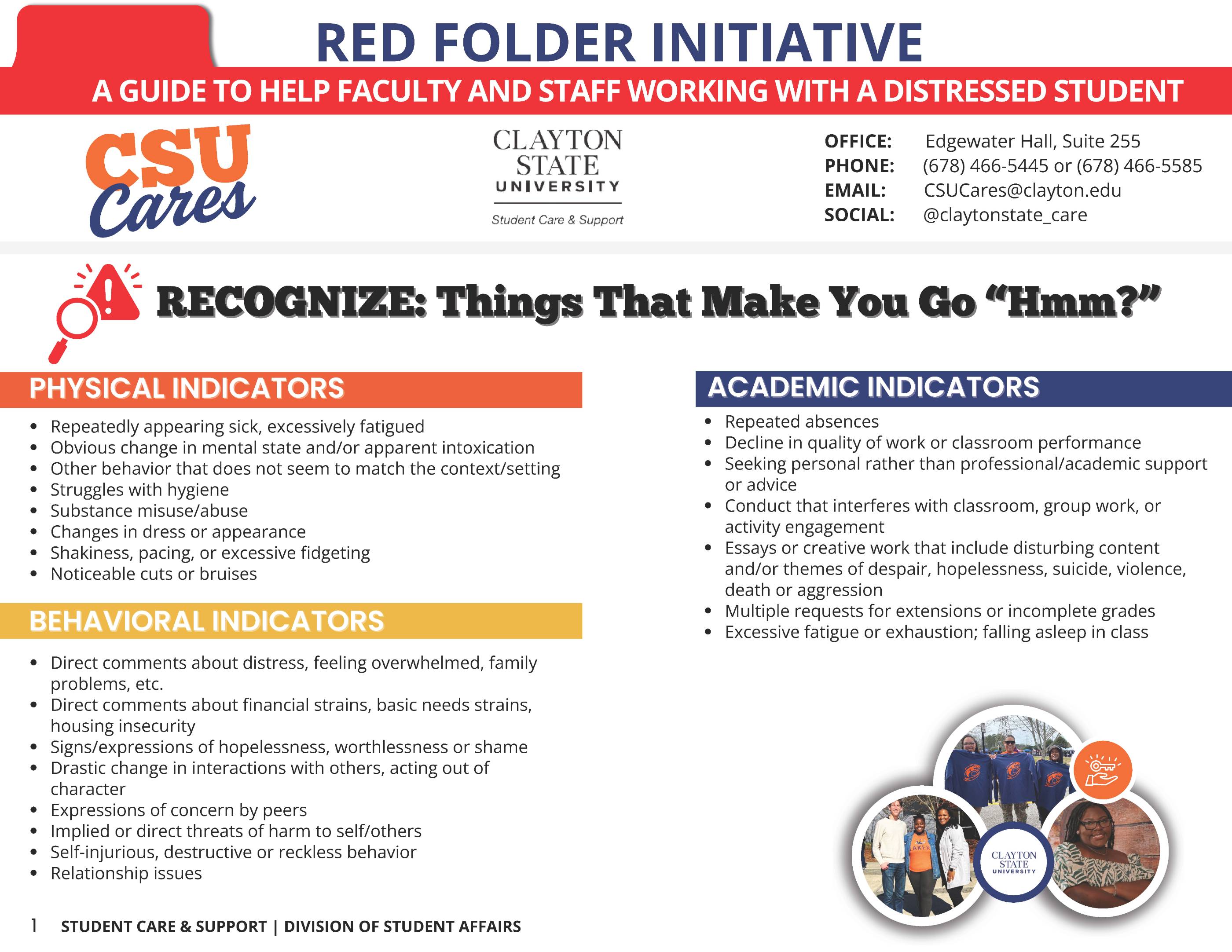
Recognize: Things That Make You Go "Hmm?"
PHYSICAL INDICATORS
BEHAVIORAL INDICATORS
|
ACADEMIC INDICATORS
|
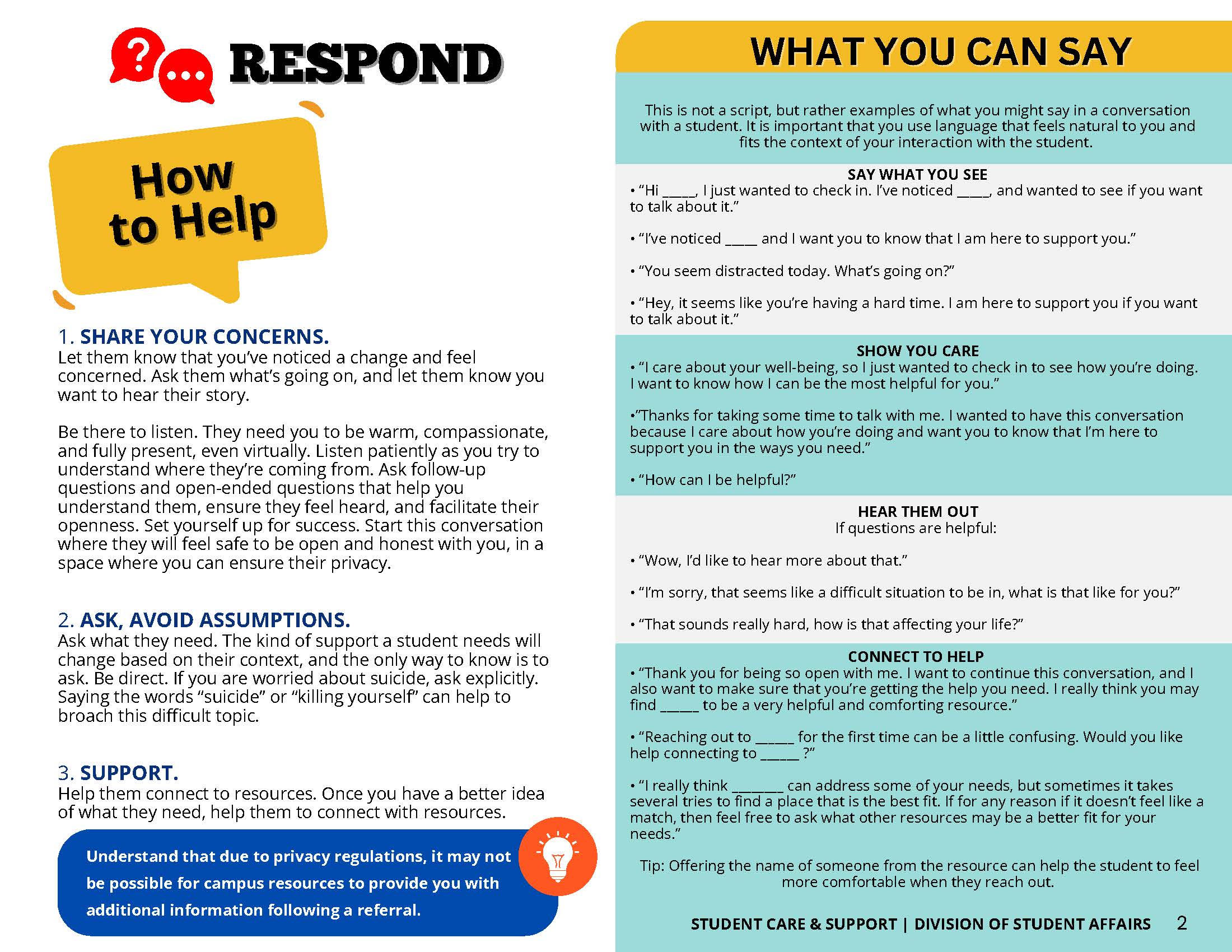
How to Help
Understand that due to privacy regulations, it may not be possible for campus resources to provide you with additional information following a referral. |
WHAT YOU CAN SAYThis is not a script, but rather examples of what you might say in a conversation with a student. It is important that you use language that feels natural to you and fits the context of your interaction with the student. SAY WHAT YOU SEE
SHOW YOU CARE
HEAR THEM OUT
CONNECT TO HELP
Tip: Offering the name of someone from the resource can help the student to feel more comfortable when they reach out. |
|
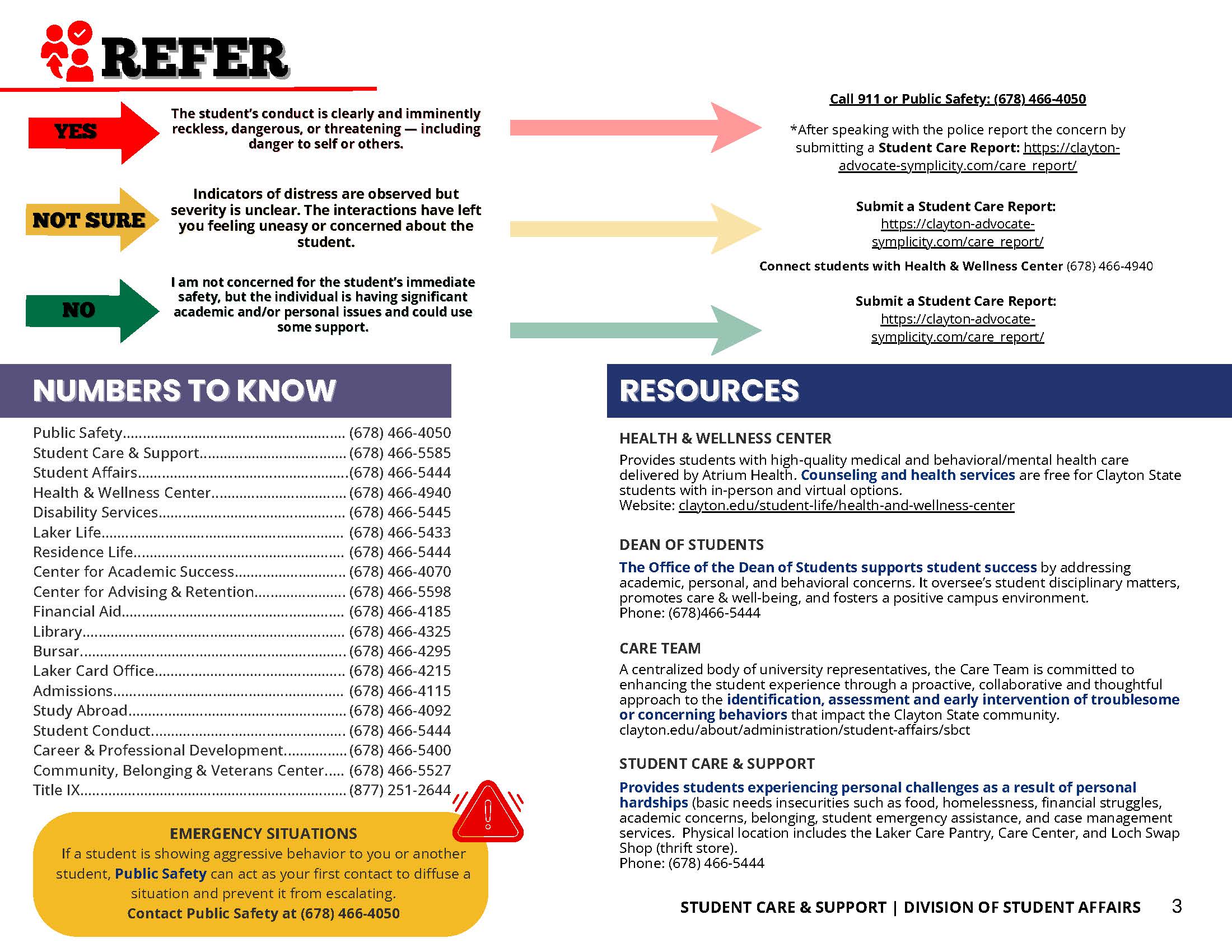
YES |
The student's conduct is clearly and imminently reckless, dangerous, or threatening - including danger to self or others. |
Call 911 or Public Safety: (678) 466-4050 *After speaking with the police report the concern by submitting a Student Care Report |
|
|
NOT SURE |
Indicators of distress are observed but severity is unclear. The interactions have left you feeling uneasy or concerned about the student. |
Connect students with Health & Wellness Center (678) 466-4940 |
|
|
NO |
I am not concerned for the student's immediate safely, but the individual is having significant academic and/or personal issues and could use some support. |
|
NUMBERS TO KNOW
Student Care & Support
Student Affairs
Health & Wellness Center
Disability Services
Laker Life
Residence Life
Center for Academic Success
Center for Advising & Retention
Financial Aid
Library
Bursar
Laker Card Office
Admissions
Study Abroad
Student Conduct
Career & Professional Development
Community, Belonging, & Veterans Center
Title IX
EMERGENCY SITUATIONS |
RESOURCES Phone: (678) 466-5444 |
|
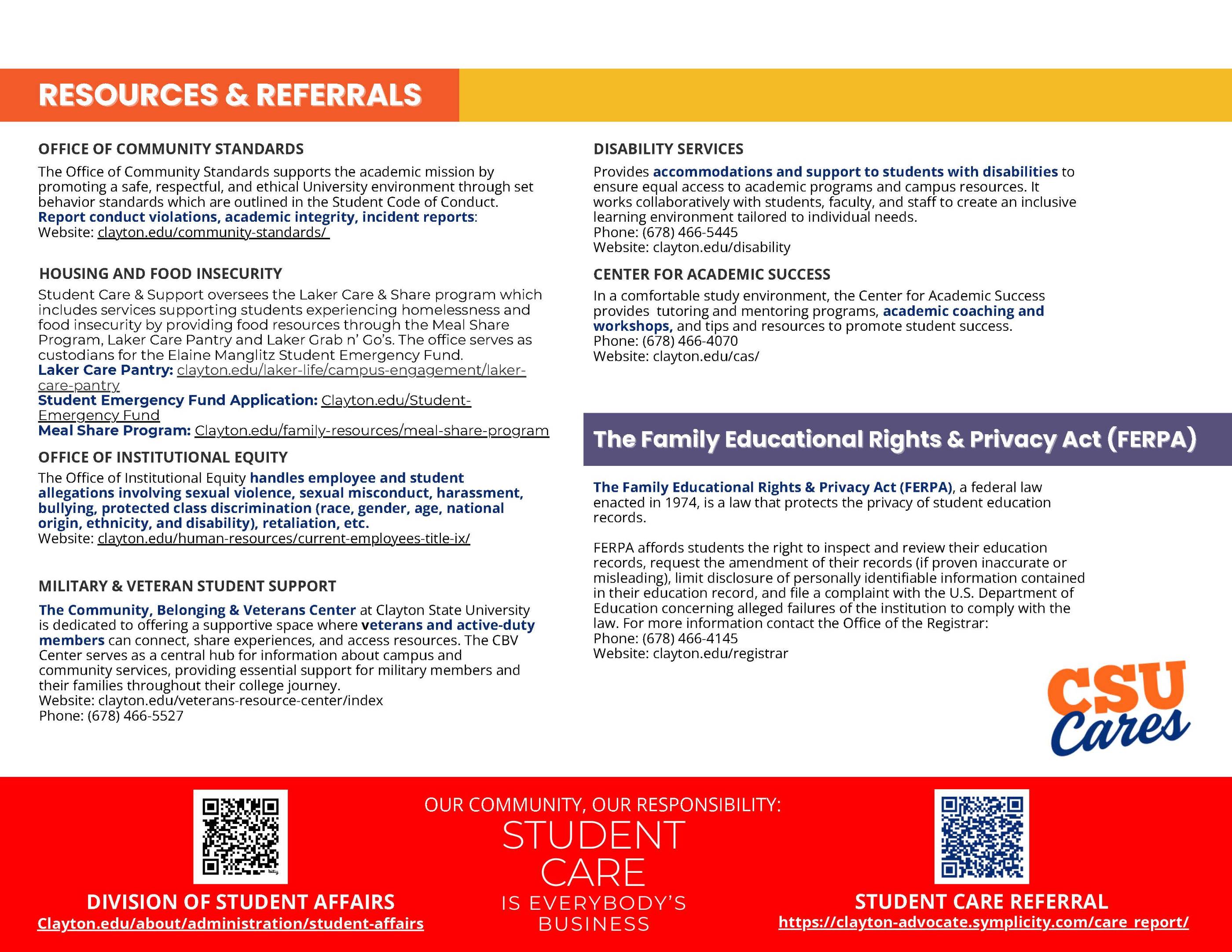
Office of Community Standards Website: Community Standards Student Emergency Fund Application Military & Veteran Student Support The Community, Belonging, & Veterans Center at Clayton State University is dedicated to offering a supportive space where veterans and active-duty members can connect, share experiences, and access resources. The CBV Center serves as a central hub for information about campus and community services, providing essential support for military members and their families throughout their college journey. Phone: (678) 466-5527 Website: Community, Belonging and Veterans
|
Disability Services Phone: (678) 466-4070 Website: Disability Services Phone: (678) 466-4070 Website: Center for Academic Success The Family Educational Rights & Privacy Act (FERPA)The Family Educational Rights & Privacy Act (FERPA), a federal law enacted in 1974, is a law that protects the privacy of student education
records. Office of the Registrar Phone: (678) 466-4145 Website: Office of the Registrar |
|
OUR COMMUNITY. OUR RESPONSIBILITY STUDENT CARE IS EVERYBODY'S BUSINESS |
Purpose
The CARE Team is a centralized body of university representatives committed to enhancing the student experience through a proactive, collaborative, and thoughtful approach to the identification, assessment, and early intervention of troublesome or concerning behaviors that impact the Clayton State University community.
Referrals can be submitted to the Online Care and Concern Report form.
Behaviors Addressed by the CARE Team
Faculty and staff members are encouraged to contact CARE through the online care and concern reporting system, email, or by contacting a member of the CARE team to report concerning behaviors.
Behaviors that warrant a report to the committee include, but are not limited to:
- Behavior that appears to be dangerous or threatening to oneself or others
- Behavior that demonstrates a student’s inability to care for self
- Unusual or strange behavior that is outside the realm of what most people would consider acceptable behavior
- Inappropriate behavior that substantially interferes with or impedes the educational experiences of others
- Unusually angry, hostile, or abusive behavior, especially if the behavior is uncharacteristic of the student’s normal behavior
- Concerns due to significant and sudden changes in academic performance, behavior, and/or attendance
- Any other student behavior that is concerning or distressing
Reporting Procedures
Any University faculty or staff with a concern about a student can access online reporting form or reach out to the team through any of the regular team members. Team members then immediately report to the chair, who triages the requests and determines the appropriateness and priority of the situation, with the assistance of any of the other team members, and convenes a meeting if necessary. The CARE team meets at minimum every other week throughout the academic year.
When the CARE team convenes, the chair and other members as needed present the information to the team for review. Discussion focuses on meeting both the identified student’s educational and personal needs, and the safety needs of the campus community. The team also addresses situations that relate to a student’s imminent danger to self, others, or the University. The CARE team makes recommendations regarding the behavior and communicates the disposition of each case to members of the CSU community, including the reporting party, as appropriate.
Potential Outcomes
The following are potential recommendations for disposition:
- No action taken
- Assist faculty or staff in developing plan of action
- Referral to existing campus support resources
- Referral to appropriate community resources
- Recommendation of parental notification
- Recommendation of a voluntary withdrawal
- Recommendation of an involuntary health withdrawal
- Referral to Office of Community Standards
- Referral to Counseling and Psychological Services for an assessment
CARE Representatives
| Representative | Name | Role |
|---|---|---|
| Dean of Students | Dr. Mya Richardson-Echols | Chair |
| Assistant Dean of Students | Ms. Sarah Ray | Co-Chair |
| Assistant Director of Residence Life | Onix Silva | |
| Director of Advising and Retention | Ms. Latrika Staples | |
| Atrium Health and Wellness Behavioral Health Program Coordinator | Ms. Shirley Chambers | |
| Director of Public Safety | Chief John Keener | |
| Faculty Member (Faculty Senate Student Affairs Committee Chair) | Dr. Nichelle Gause | |
| Vice President for Student Affairs (ex-officio) | Dr. Takeem Dean |