
The Three-Minute Teaching Moment Showcased the Latest Teaching Tech and Tips for Engaging Students
(May 4, 2026) - Participants in the Three-Minute Teaching Moment (3MTM) included Dr. Carol White, Department of Humanities, College of Arts and Sciences; Dr. Carin Lightner-Laws, College of Business, Management, Marketing and Supply Chain; Professor Shirnelle Council, College of Business, Lecturer of Business Law; Dr. Christie Burton, College of Business, Professor of Management; and Director Penny Cliff, College of STEM, Director of Archives and Information Studies.
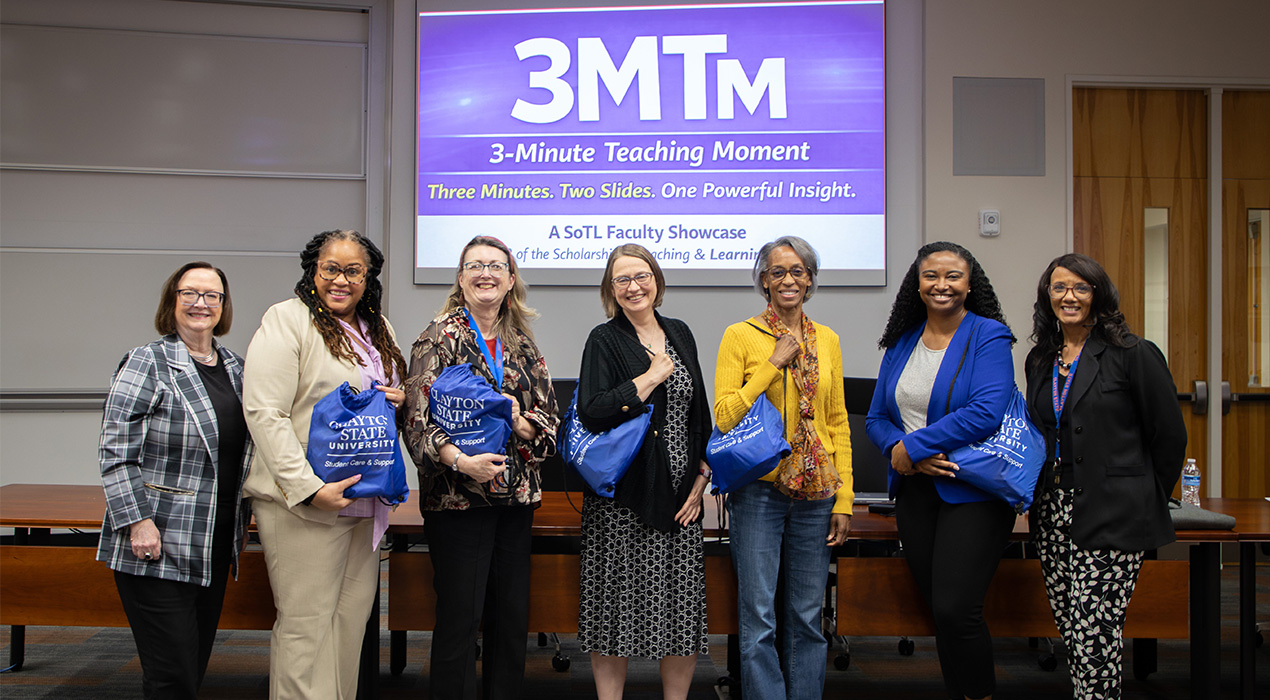
The 3MTM event was sponsored by the Center for Excellence in Learning and Teaching (CELT) with CELT Executive Director, Martha Fairley, Ed.S. and Dr. Joie Hain, College of Business, Management, Marketing, and Supply Chain Management, serving as event facilitators.
Modeled after the well-known Three Minute Thesis (3MT) format, this event invites faculty to briefly showcase a meaningful teaching insight in a concise, engaging format: three minutes and up to two slides. Rather than presenting an entire research project or course, faculty will highlight a single impactful teaching moment—a best practice, lesson learned, or classroom challenge—and the instructional change or insight that emerged from the experience. The goal of 3MTM is to build community around teaching innovation while advancing the Scholarship of Teaching and Learning (SoTL) at Clayton State University.
From the excerpts from the presentations that follow, you can see that all who attended the event gained valuable insights into best practices for using the latest classroom technology and techniques to keep students engaged and learning.
According to Shirnelle Council, “The loudest voices can sometimes dominate the conversation, while some of the most profound voices can remain silent. This is not necessarily due to a lack of knowledge and confidence, but a failure at times to create an environment where all personalities can thrive.”
Traditionally, Council says professors tend to cold-call students without warning to keep them on their toes and engaged in the lecture. But when she shifted her approach to tell students that everyone would be asked for their feedback on a topic and called on students from front to back, engagement improved significantly.
“The results have been transformative. When students know what is expected, the classroom dynamic shifts from performance to contribution. I see students show greater engagement in note-taking because they know they will be called upon during our rapid-fire event. I've also seen students who are otherwise very reserved or unwilling to share their thoughts, open up and provide real-world examples from their own experience.
Penny Cliff observed that today, “students live in an instantaneous, attention-fragmented culture. When I taught history, I leaned into that reality by opening class with a short music video that was tied to the theme. It was different every single time, and the students really got used to doing this. So, for instance, let's say we were talking about World War Two. The music that comes to mind is the 007 movie theme.”
In addition to grabbing students' attention as soon as they walk into the class with a music video, Cliff kept the students engaged by “immediately moving into a quick trivia activity based on the readings, which they were supposed to have done before they came to class.” She added that students could use their cell phones in other learning exercises, which is another way to keep them involved with her lectures.
Dr. Carol White, professor of history, shared that in 2023, she “implemented specifications grading in my lower-level contemporary world history class. This course requires students to read 3 non-fiction monographs, something many incoming college students have likely never done.” Non-fiction monographs are specialized, in-depth studies focusing on a single, specific subject, usually authored by a researcher or expert.
Dr. White saw the value in mandating that students follow this approach to learning. She said a study examining why students failed to complete reading assignments found that students were afraid they couldn’t understand the material. In her class, “Each assignment covered just a few chapters at a time. The assignments varied, but they all required the students to summarize and explain what they had read.” Professor White found that compelling students to go through this process helped build their confidence that they could understand the required reading.
Dr. Carin Lightner-Laws agrees with her colleagues that students are challenged by the demands of balancing work, family, and classwork. She shared how her approach to engaging students has changed over the years. “24 years ago, we told students to put away their phones because they were a distraction. Today, I'm saying the exact opposite. Let's embrace it. Let's pull it out and use that as an engagement tool.”
Dr. Lightner-Laws uses cell phone apps like Poll Everywhere and Mentimeter to engage her students. She said, “Those are ways that students can be asked a question and then their responses, you see them live.” Mentimeter acts as a slide deck builder (like PowerPoint/Keynote). Poll Everywhere serves as an overlay that adds activities to existing PowerPoint/Google Slides presentations. Mentimeter uses modern word clouds and ranking. Poll Everywhere focuses on flexible question types, including clickable images.
Another benefit of leveraging these apps, she pointed out, was that “with a tool I use in class called Kaltura, instead of a student putting on a video and then not watching it. You can make sure that they watch the video, they can't fast forward it, and not only that, but they also have questions and quizzes embedded within the videos.”
The three-minute teaching moment concluded with a hotly debated topic: how and when students should use AI in higher education. Dr. Christie Burton shared that “In my Ethics, Technology and culture course, I design discussion into a structured two-day debate, paired with intentional use of generative AI. I asked AI to generate edgy topics connected to marketplace contents, and then students created real-world issues like whether AI-generated art is truly creative, and whether social media companies should be held responsible for user content.”
Dr. Burton explained how she structured the debates and how AI was incorporated in the learning exercise. She said that “On day one, students worked in groups and were assigned a position to defend, but used AI to research both sides of the issue. On day two, during the debate, they used AI in real time to develop models, generate counterarguments, and strengthen their floating arguments.”
In the end, the two-day debate class was a learning experience for the professor and her students. Dr. Burton shared that “I think the key to why this worked is that it wasn't just debate, and it wasn't just using AI. The key was structuring it in a way that complemented the other. We have to design experiences where students actively wrestle with ideas and then give them tools to help them do that well.” She added that, during the process, everyone was a little anxious because it was a new way of approaching a group learning exercise. “It can feel a little uncomfortable to have all of this in real time, but it was energizing, and the students were surprised at how much they learned.”